Lesson 16 · Coffee in Pakistan
Can coffee grow in Pakistan?
Possibly, in a few carefully chosen microclimates. But a plausible climate is not the same as a proven coffee origin.
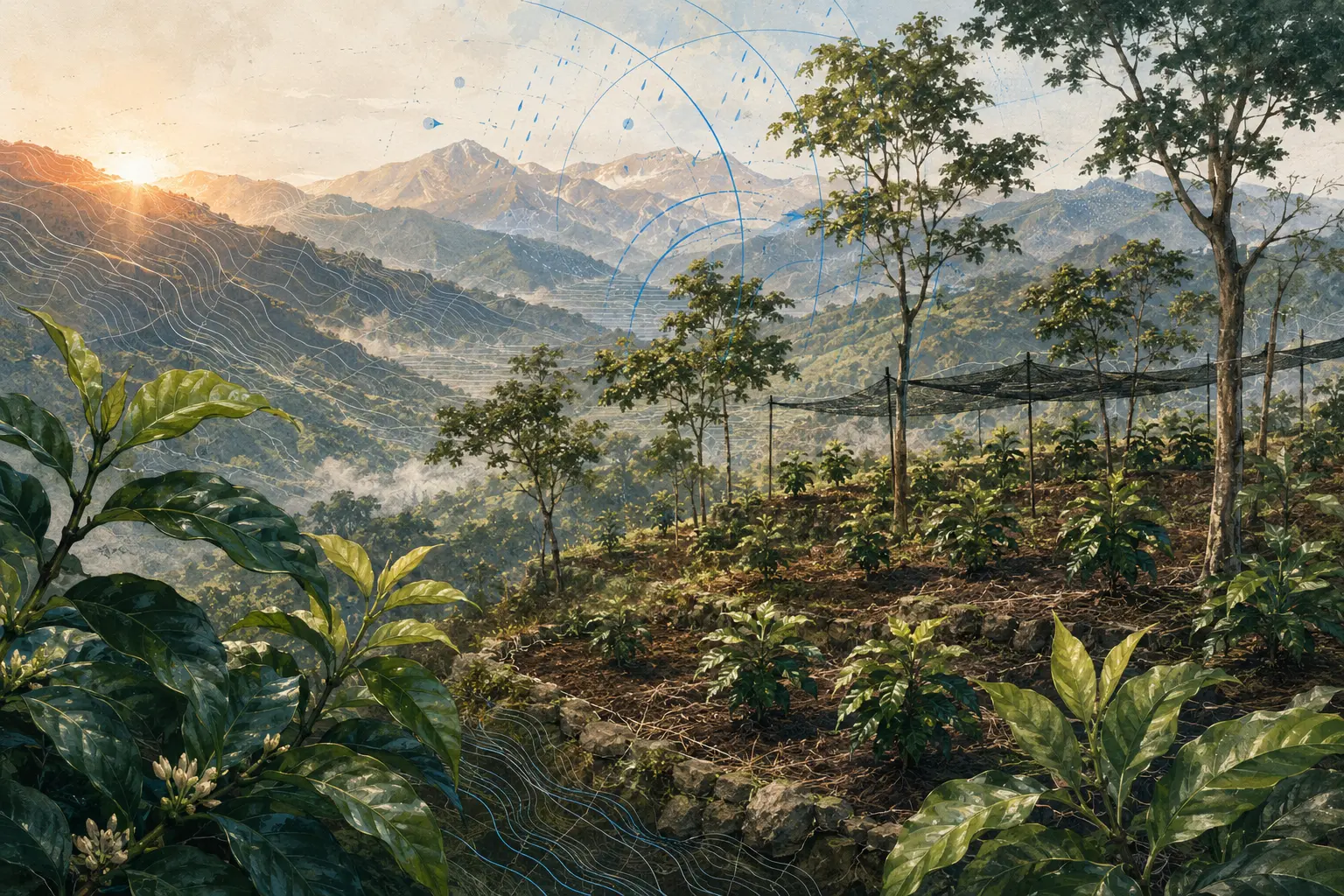
The short answer: testable, not proven
Coffee is a tropical and subtropical perennial crop. Pakistan sits well north of the equatorial coffee belt, but latitude alone does not settle the question. Elevation, slope, temperature, frost, rainfall, irrigation, shade, soil and local weather can combine to create small that differ sharply from the surrounding region. That makes experimental cultivation conceivable in selected northern foothills.
Conceivable is not the same as commercially viable. Atlas could not find a public, independently documented record of a producing Pakistani coffee region with repeat harvests, traceable processing and . A nursery plant, ornamental tree or one season of cherries would not prove that farmers can produce stable at a workable cost. Pakistan should therefore be described as an untested origin, not an emerging origin, until field evidence exists.
What Arabica actually asks of a place
generally performs best in cool, frost-free highland conditions. The FAO cultivation manual uses more than 1,000 metres as a useful elevation reference in its tropical context, an optimum daily temperature of roughly 20–24°C and annual rainfall above about 1,200–1,500 millimetres with a useful distribution across the growing season. It also warns that temperatures above 30°C stress the plant, means below 15°C restrict growth and frost can kill vulnerable tissue.
Those figures are not a universal planting recipe. The effect of elevation changes with latitude; a site in Pakistan does not behave like a site at the same height near the equator. Coffee also needs oxygenated, well-drained soil, reliable water during growth, a drier signal that helps coordinate flowering, protection from destructive wind and enough warmth for cherries to ripen. A site can match the annual average while failing because of a few nights of frost, a heat wave during flowering or poorly timed monsoon rain.
- Temperature: measure hourly extremes, not only annual averages.
- Water: distinguish total rainfall from water that reaches the root zone.
- Topography: avoid frost pockets and waterlogged valley bottoms.
- Soil: test depth, drainage, organic matter, pH and salinity before planting.
Where a Pakistani trial might begin
A first screening could examine lower-to-mid-elevation pockets around the Murree and Hazara foothills, parts of Abbottabad and Mansehra, transitional valleys in Swat or Dir, and suitable mid-elevation belts of Azad Jammu and Kashmir. These are hypotheses, not recommended coffee regions. Within any one district, two slopes a few kilometres apart may have very different frost, sunlight, wind and water exposure.
The highest, coldest sites are not automatically better. They may protect Arabica from extreme summer heat but expose it to frost and prevent cherries from ripening. Lower sites may escape severe cold yet become too hot in summer. The useful zone, if one exists, will likely be a sheltered, well-drained slope with irrigation, filtered shade, manageable winter lows and a sufficiently long warm season.
Murree illustrates why a single climate statistic can mislead. Pakistan Meteorological Department research shows substantial seasonal rainfall at the station, but also explains that intense rain can be lost as runoff rather than becoming effective water for crops. Coffee roots need available moisture and drainage; a heavy monsoon does not remove the need for soil and irrigation studies.
Pakistan's hardest agronomic questions
Winter is the first filter. Arabica is frost-sensitive, and cold air collects in hollows and valley bottoms. A sloping site with air drainage, shade and wind protection may reduce risk, but it cannot make a severe frost harmless. Summer is the second filter: sustained heat can suppress photosynthesis and damage flowering. Pakistan's warming climate makes historical averages less dependable, so a trial should use recent observations and future heat projections.
Water is equally complicated. Monsoon timing, dry-season length, irrigation quality and drainage determine whether a tree experiences useful moisture or damaging stress. Saline water and poorly drained soil can undermine an otherwise promising climate. Then come unfamiliar pests and diseases, suitable planting material, nursery health, pruning, nutrition and the labour needed to pick ripe cherries selectively.
Finally, growing cherries is only half the system. A new origin needs small-scale pulping or natural-processing facilities, controlled , drying protected from rain and contamination, moisture measurement, safe storage, hulling, grading, roasting and independent sensory evaluation. Without those steps, the experiment measures tree survival rather than coffee quality.
What a serious trial would look like
Begin with climate and soil mapping, then choose three to five contrasting micro-sites rather than betting on one farm. Each site should install a weather station and plant a deliberately small, replicated plot under recorded shade and irrigation conditions. Several Arabica should be compared, including material selected for disease resistance and climate resilience. Planting material must enter through legal, channels.
For at least three to five years, record survival, vegetative growth, flowering dates, fruit set, cherry development, pests, disease, heat injury, frost injury, irrigation, labour and yield. Process each lot separately under documented protocols. When harvest size permits, evaluate physical quality and cup character with qualified external assessors. Publish poor results alongside promising ones so future growers do not repeat expensive mistakes.
- Year 0: screen climate, soil, water and legal access to healthy plant material.
- Years 1–2: compare establishment, heat and winter survival across sites.
- Years 3–5: measure flowering, harvest, processing behaviour, yield and cup quality.
- Decision gate: expand only if agronomy, sensory quality and farm economics all hold up.
Could it become specialty coffee?
Specialty potential cannot be inferred from altitude or species. The coffee must be healthy, picked and processed well, physically sound, roasted competently and evaluated in context. A distinctive Pakistani cup would be exciting, but novelty should not lower the evidence bar. The first useful result might be that a particular zone is unsuitable, and that would still be valuable research.
Economics may prove more difficult than botany. Coffee takes years to establish, ties up land, needs skilled seasonal labour and competes with crops farmers already understand. A trial should compare expected income, water use and climate risk with existing horticulture. If the only way to produce a small amount of coffee is through costly protection and irrigation, it may remain a research or tourism crop rather than a viable livelihood.
The opportunity beyond farming
Pakistan does not need domestic farms in order to build a serious specialty-coffee culture. Roasters, importers, café owners, baristas, equipment technicians, educators and drinkers already create local value around coffees grown elsewhere. Better green-coffee storage, transparent sourcing, water treatment, roasting, staff training and brewing consistency can improve the scene now.
A Pakistani cultivation programme would be worthwhile if universities, horticultural departments, farmers and coffee professionals treat it as open research. Atlas would document the sites, methods, harvests and failures without declaring victory early. The most authoritative answer today is simple: coffee growing in Pakistan is a credible research question, not yet a proven industry.
Course complete · return to lesson 01
What specialty coffee actually means
Quality is more than a score, and a beautiful café is not evidence.
Next lesson