Lesson 02 · Start here
Coffee is a fruit before it is a drink
Follow one coffee seed from a flowering tree to the cup, and see where quality can be protected or lost along the way.
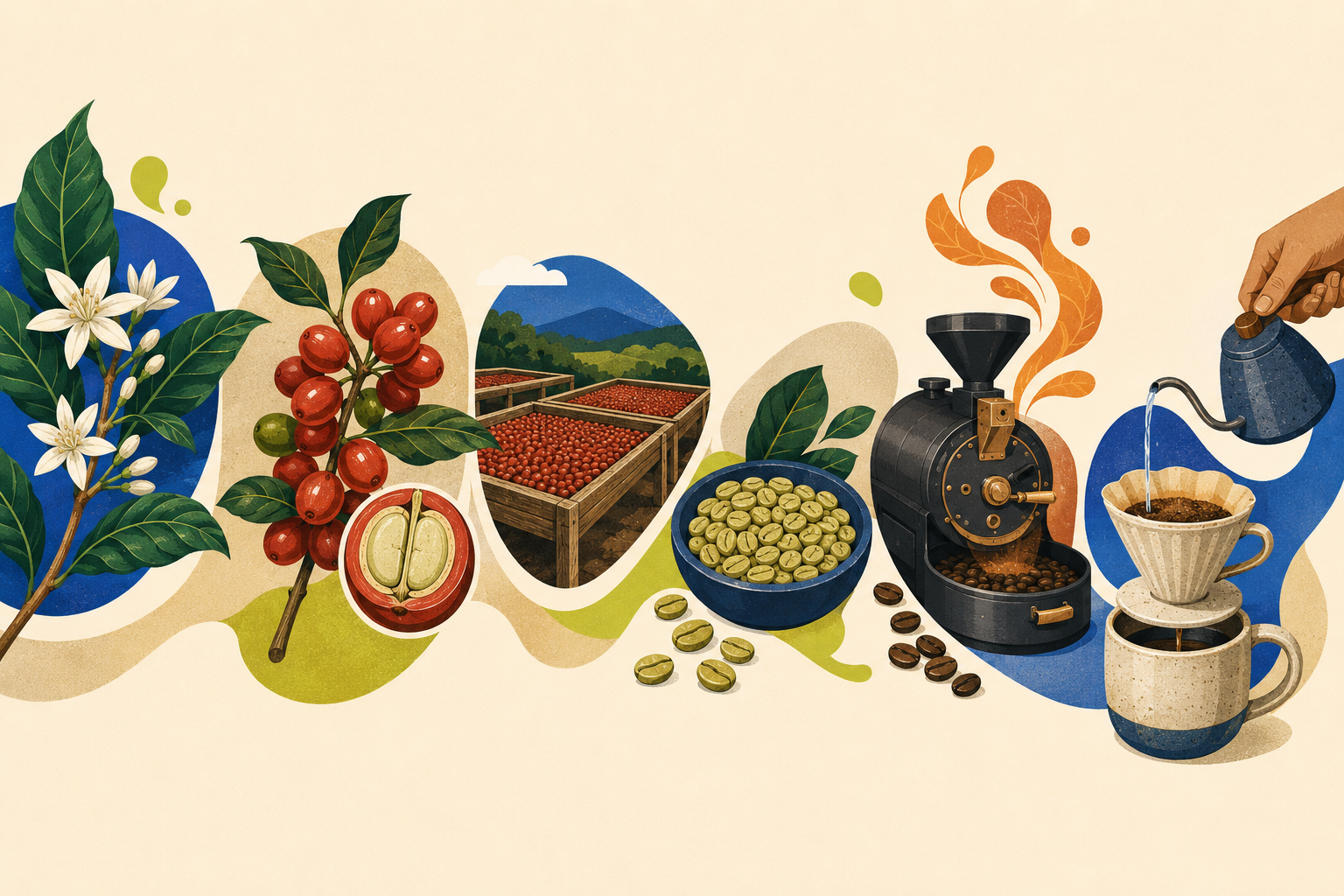
The journey begins on a living tree
Coffee trees are evergreen plants in the genus Coffea. The two species most drinkers encounter are and , often called robusta. Arabica contains enormous genetic and sensory diversity; canephora is not automatically low quality. Species, , climate, soil, shade, farm practice and plant health all interact before a cherry is ever picked.
After fragrant white flowers appear, fruit develops along the branch. Ripening takes months, not days. A ripe cherry usually holds two seeds with their flat sides facing each other, although a single round seed can develop as a . Around those seeds are skin, fruit flesh, sticky , and a thin silverskin. Calling the seed a bean is convenient, but remembering the fruit makes processing easier to understand.
- Coffee is generally harvested once the fruit reaches the producer’s chosen ripeness.
- Selective hand-picking can separate ripe fruit, while strip or mechanical harvesting requires careful sorting later.
- Uniform ripeness is valuable because under-ripe and over-ripe fruit can behave differently during processing.
Harvest is a quality decision
Picking is not merely transport from tree to mill. It is the first major selection step. Producers may pay pickers by weight, by day or with premiums for ripe cherry; each system changes incentives. On some farms a floating or density step helps remove visibly defective, dried or insect-damaged fruit. Sorting costs time and money, which is one reason traceable, carefully prepared coffee can cost more.
The phrase “hand-picked” is not a quality guarantee on its own. What matters is what was picked, how it was sorted and how quickly it moved into the next stage. Atlas treats a process claim as useful context, not a magic word.
Processing separates seed from fruit
In a , much of the fruit is removed before drying. or mechanical action helps detach remaining mucilage, after which the coffee is washed and dried. In a , intact cherries dry before hulling. families remove the skin while leaving some mucilage during drying. Producers also use many controlled variations involving sealed tanks, selected yeasts, temperature management or staged drying.
These labels describe broad routes, not guaranteed flavours. A washed coffee can be fruit-forward; a natural can be clean and delicate. Variety, ripeness, fermentation control, drying conditions and storage still matter. If a bag says only “,” useful questions remain: in what container, for how long, at what temperature, and before or after depulping?
Drying makes coffee stable enough to travel
Freshly processed coffee contains too much moisture for safe storage. Producers dry parchment coffee or whole cherries on patios, raised beds, mechanical dryers or combinations of these. They turn and sort it to encourage even drying and reduce mould or fermentation defects. Drying too fast can stress the seed; too slowly or unevenly can create other risks.
After drying and resting, coffee is hulled to remove parchment or dried fruit. It can then be graded and sorted by size, density, colour and defects. is packed for export, often with a protective liner, and moves through warehouses, ports and importers. Heat, moisture and time continue to matter even though the coffee now looks inert.
Roasting turns a dense seed into something brewable
Green coffee is hard, grassy-smelling and not ready for a grinder. A roaster applies heat while controlling time, energy and airflow. The seed loses moisture, expands and undergoes hundreds of chemical reactions that create aroma, sweetness, acidity, bitterness and colour. A roast profile is a set of decisions made for a particular coffee and intended use, not simply a light-to-dark colour slider.
Roasting cannot add quality that was never present, but it can reveal or obscure what is there. Very light roasting can leave a coffee difficult to extract; excessive development can mute origin character. Good roasting is repeatable enough that the café or home brewer can dial in from a stable starting point.
Grinding and water finish the story
Grinding creates thousands of particles and dramatically increases surface area. Fine particles extract quickly; larger particles extract more slowly. No grinder creates perfectly identical pieces, so particle distribution and brew method matter. Grind just before brewing when possible, then use dose, water, temperature, time and agitation as controlled variables.
The drink is mostly water. Water chemistry changes extraction and taste, while temperature changes the rate at which compounds dissolve. A careful producer and roaster can do everything right and still be represented badly by stale beans, unsuitable water or an uncontrolled recipe. That is why Atlas connects coffee records to brew guidance and personal logs rather than treating a bag description as the end of the journey.
Next · lesson 03
From a forest seed to a global specialty movement
Coffee history is not one heroic discovery story. It is a long movement of plants, people, trade, technology, power and changing ideas of quality.
Next lesson