Lesson 03 · Start here
From a forest seed to a global specialty movement
Coffee history is not one heroic discovery story. It is a long movement of plants, people, trade, technology, power and changing ideas of quality.
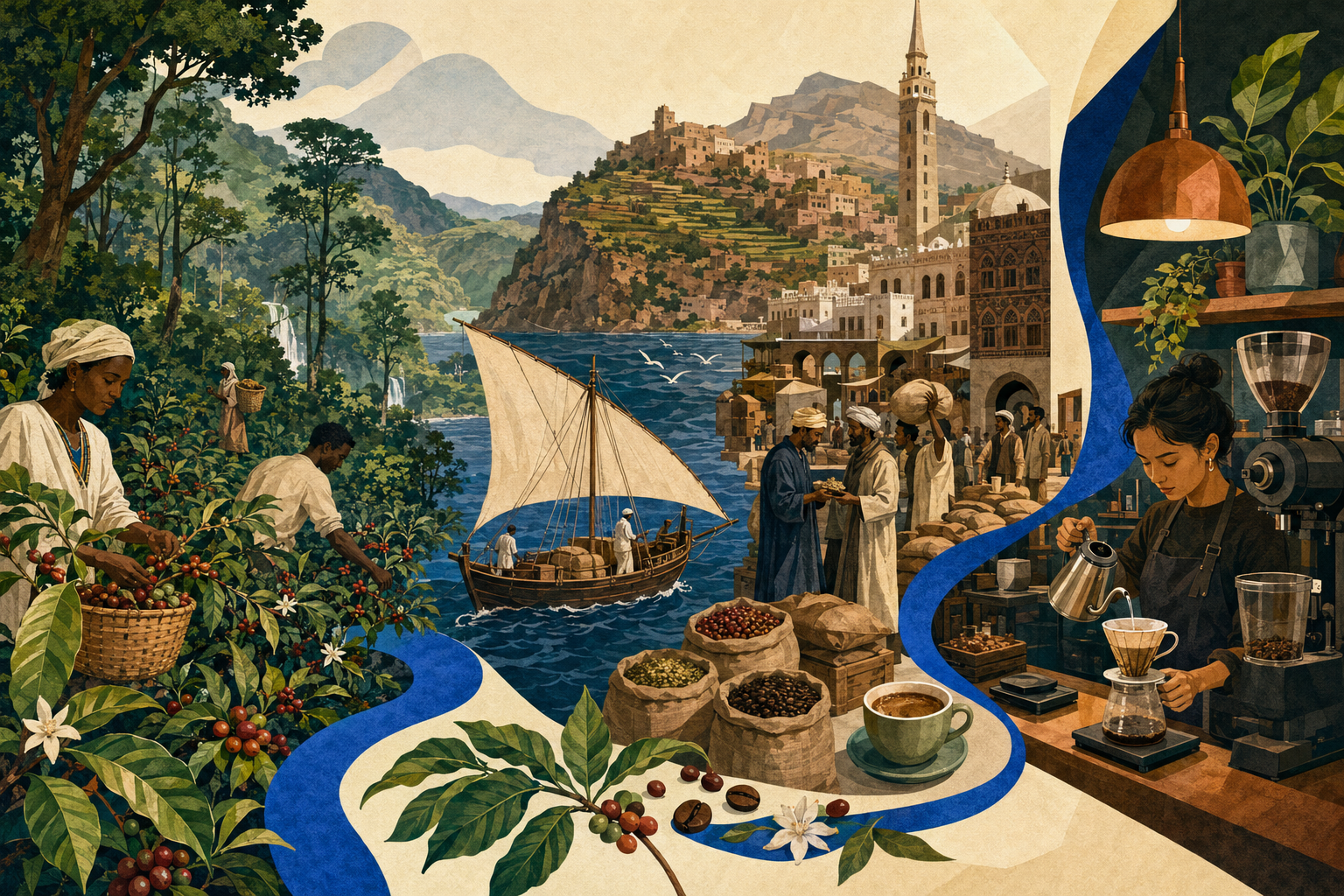
Begin with evidence, not the goat story
Popular retellings often begin with Kaldi, an Ethiopian goatherd whose animals supposedly became energetic after eating red cherries. It is memorable folklore, not a securely documented origin account. The more important evidence is botanical: is indigenous to the highland forests of Ethiopia and neighbouring parts of Africa, where coffee plants and coffee traditions have deep histories.
Coffee did not move from “discovery” to cappuccino in one clean line. People used the plant in different ways, records are incomplete, and oral traditions matter. Atlas will distinguish legend, documented history and modern interpretation rather than present a neat myth as fact.
Yemen made coffee a cultivated and traded drink
By the fifteenth century, coffee cultivation and consumption were established in Yemen. Sufi communities are often associated with drinking coffee to remain alert during devotional practice. The Red Sea port of al-Makha, rendered in European languages as Mocha, became closely linked to the export trade. That place name later became attached to a chocolate-coffee drink, but its coffee history came first.
Coffeehouses appeared across cities of the Ottoman world. They offered more than refreshment: people gathered for conversation, games, performance, news and argument. Authorities periodically viewed these spaces with suspicion, a reminder that coffee’s social power has always extended beyond the cup.
Global demand moved plants and power
European merchants and colonial powers sought to break Yemen’s control over supply. Coffee plants were transported to new growing regions in Asia, the Caribbean and the Americas. Java became so important under Dutch colonial production that its name became shorthand for coffee. France, Portugal and other empires expanded cultivation elsewhere.
This expansion depended heavily on colonial land systems, slavery, indenture and other forms of coerced or poorly compensated labour. The modern coffee market still carries structural inequalities created across these centuries. A responsible history cannot celebrate coffee’s global journey while erasing the people who produced its value.
Industrial coffee made the drink ordinary
Roasting, packaging and transport changed rapidly in the nineteenth and twentieth centuries. Branded roasted coffee, vacuum packing, instant coffee and mass retail turned coffee into an everyday commodity for millions. Espresso technology developed in Italy, enabling concentrated coffee to be prepared quickly in cafés; later pump machines and temperature control changed the style and consistency of espresso.
Scale made coffee accessible, but commodity buying often blended away identity. Consumers learned brand names more readily than farms or . Convenience and consistency became dominant forms of value. did not replace this system; it grew alongside it and often defined itself in contrast to it.
Specialty became a new language of value
The modern term “specialty coffee” is commonly associated with Erna Knutsen, who used it in the 1970s to describe coffees from particular with distinctive flavour. From there, roasters, importers, producers, green buyers, café operators, competition communities and professional associations built systems for evaluating, trading and preparing differentiated coffee.
The movement is sometimes described in waves: mass-market coffee, espresso-bar culture, then origin-focused craft. The model is convenient but oversimplified and centred on particular consumer markets. Coffee-producing communities had quality knowledge long before affluent drinkers learned farm names. Today’s better question is not “which wave are we in?” but “whose work is visible, who carries risk, and who receives value?”
Specialty today is broader than a score
For years an 80-point threshold was widely used as the shorthand definition of specialty. Scoring remains useful in trade, but one number cannot fully represent flavour description, personal preference, provenance, sustainability, price, cultural meaning and the quality of roasting or service. The ’s Coffee Value Assessment reflects a wider effort to separate descriptive, affective, physical and extrinsic information.
For Atlas, specialty is an evidence-led promise: a coffee or café should make quality, sourcing and preparation claims that can be examined. We keep coffee records, branch records and user experiences separate. A beautiful room is not proof of specialty; an expensive bag is not proof either. Transparency helps people make their own informed choices.
Pakistan is writing its own chapter
Pakistan’s contemporary specialty scene is young enough that discovery still happens through Instagram stories, private recommendations and scattered shop pages. Roasters import , train baristas and introduce origin-led menus while drinkers learn new brew methods and flavour language. Equipment access, water, heat, shipping and price all shape the local experience.
Atlas exists to document that chapter as it happens: verified café records, current coffees, openings, events, equipment sellers, practical education and original conversations. The aim is not to imitate a foreign coffee city. It is to make Pakistan’s own specialty ecosystem easier to see, learn from and participate in.
Next · lesson 04
How to read a coffee bag
Country is the beginning of the record, not the recipe and not the whole story.
Next lesson