Lesson 04 · Start here
How to read a coffee bag
Country is the beginning of the record, not the recipe and not the whole story.
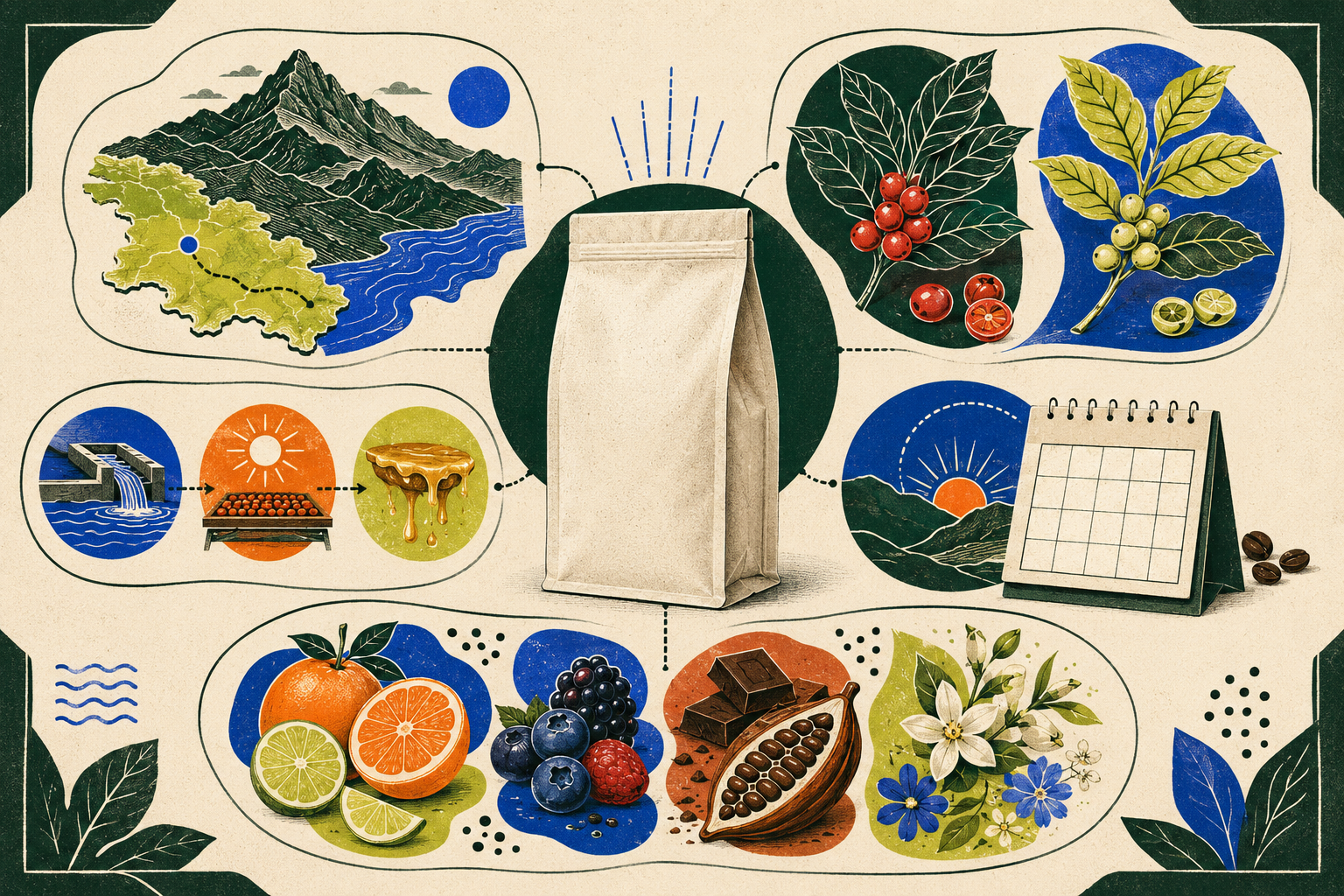
Start with identity
Country, region, farm or washing station, producer, lot and are different levels of identity. A blend may intentionally combine several origins. A single-origin label can still cover many farms or a large cooperative. More detail can be useful, but detail alone does not prove quality.
Look for wording that makes the level clear. If the region is missing, Atlas marks it unpublished. We do not infer a precise place from a country name or reuse details from a similarly named coffee.
Process describes handling after harvest
Washed, natural and are broad process families. Experimental terms such as , or thermal shock can describe meaningful techniques, but the label becomes more useful when the producer provides sequence, time, temperature or vessel information.
Process may help you anticipate a style, not guarantee it. Naturals are often associated with fruit intensity; with clarity. Treat that as a hypothesis for tasting, not a rule for changing the .
Roast information is not standardised
One roaster’s medium can resemble another’s light. “Filter” and “espresso” can describe intended use, but many coffees work across methods. A roast date is more concrete. Very fresh coffee can release abundant gas and behave unpredictably; older coffee often needs a finer grind or more , but there is no universal expiry day.
Buy an amount you can use, store it sealed away from heat and grind just before brewing. If a bag provides a recipe, treat it as the roaster’s tested starting point for that coffee.
Tasting notes are a map, not ingredients
Blueberry, cocoa, citrus or florals normally name sensory associations noticed by a roaster or taster. They do not mean those ingredients were added. The notes may shift with water, recipe, temperature and your own food memory. A colder cup often reveals different sweetness and than the first hot sip.
Use notes to compare rather than to pass a test. “This reminds me more of dark chocolate than berries” is useful. Not finding bergamot does not mean you failed.
Turn the label into an action
Choose a method, use a balanced baseline and record dose, water, grind and time. If the roaster provides a recipe, start there. If not, Atlas can build a method-led recipe. Change one variable after tasting. The bag gives context; your repeatable brew creates evidence.
Next · lesson 05
Species, varieties and why coffee names multiply
Arabica and robusta are species. Bourbon, Typica and Gesha are varieties. None is a shortcut to the taste in your cup.
Next lesson