Atlas Library · Café operations
The first coffee of the day costs more than you think
How to dial in espresso without wasting quality, coffee or money, with a calculator built into the article.
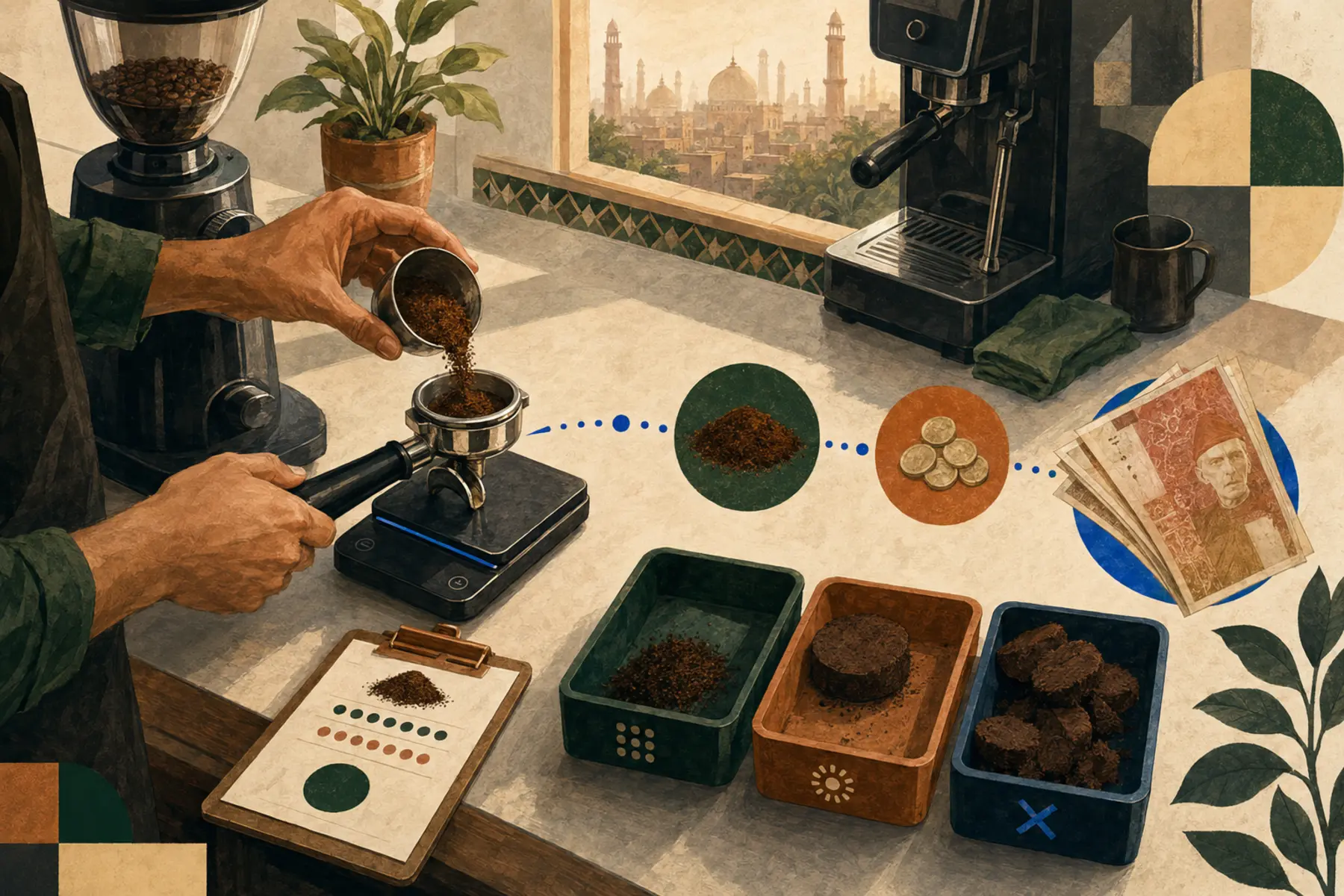
Before the first customer
Before the first customer arrives, a café may already have used six, eight or even twelve espresso doses. One shot ran too slowly. The next tasted sharp. The grinder was adjusted, so a little coffee was purged. A new bag was opened. Someone changed the grind again after the machine warmed up.
This is not automatically bad practice. Espresso must be checked before it is served. The problem begins when nobody can explain how much coffee was used, why it was discarded or whether the same problem returns every morning.
A café does not need to eliminate dial-in coffee. It needs to understand it.
Espresso changes throughout the day
Espresso is affected by connected variables including dose, beverage yield, grind size, water temperature, pressure, flow and contact time. Changing one variable can influence the others. Research on espresso shows that particle size, water flow and temperature interact. A very fine grind does not automatically produce better extraction. It can encourage uneven water flow, reduce repeatability and sometimes produce a worse cup.
The grinder changes too. Heat builds during service. Coffee ages after the bag is opened. Humidity can change. A full hopper may behave differently from a nearly empty one. Moving the grind setting can also leave coffee from the previous setting inside the grinder.
This is why a recipe should be a starting structure, not a promise that every shot will behave identically.
Begin with a named recipe
‘Make it taste good’ is not a usable opening procedure. The barista should know which coffee is being used, its roast and bag-opening dates, the intended dose, target beverage yield, approximate extraction-time range, intended flavour and the drink in which it will be served.
A starting recipe might use an Ethiopia Guji at 18 grams in, 38 grams out, 93°C and an initial time range of 27 to 31 seconds, with a goal of floral aroma, clear sweetness and a clean finish. Extraction time is an observation, not the final judge. A shot landing at exactly 29 seconds can still taste unpleasant. A balanced espresso at 32 seconds should not be rejected simply because it missed a number.
reporting on contemporary espresso preparation found wide variation in recipes, although weighing beverage yield and using roughly a 1:2 relationship were common practices. This describes industry behaviour. It is not a rule that every coffee must follow.
- Name the coffee, bag and recipe before changing the grinder.
- Measure dose and beverage yield for every comparison shot.
- Describe the intended flavour in words the whole team understands.
- Record who approved the recipe for service.
Change one thing at a time
Changing the dose, grind and yield together makes the result difficult to understand. Confirm the dose, measure the beverage yield, taste the espresso, identify the clearest problem, change one variable and then compare the next shot.
If the shot tastes thin and sharp and finishes too quickly, try a slightly finer grind while keeping dose and yield stable. If it tastes dry, harsh or hollow, a coarser grind or shorter yield may help. The correct adjustment depends on what the cup is communicating.
The purpose is not to teach a rigid flavour equation. It is to make each adjustment understandable.
Decide when dial-in is finished
Without a stop condition, dial-in can become endless. An espresso is ready for service when the recipe is repeatable across at least two shots, its main flavour character is clear, sweetness, and bitterness feel appropriate, it works in its intended drinks and the responsible barista can explain the final adjustment.
The café should decide who can approve the recipe. During opening, that might be the head barista or shift lead. During service, other baristas may make small corrections inside an agreed range. This prevents several people from independently moving the same grinder.
Measure waste in grams, not guesses
A shift sheet might say ‘two shots wasted,’ but shots can use different doses. Grams create a consistent record. A small container on a scale can capture dry coffee purged from the grinder. Discarded espresso doses can be recorded with one tap or counted on a shift sheet. The important part is assigning a reason without interrupting service.
- Opening dial-in
- Grinder purge
- New bag or coffee lot
- Weather or temperature correction
- Staff training
- Remake
- Recipe testing
- End-of-day coffee
- Unexplained waste
What does the waste cost?
Consider a café using coffee priced at PKR 4,000 for a 250-gram bag. The cost is PKR 16 per gram. Six 18-gram dial-in shots use 108 grams. Add 36 grams of grinder purging and one 18-gram remake, and the total reaches 162 grams. The daily bean cost is PKR 2,592. If that pattern continued for 30 days, the bean cost would be PKR 77,760.
This is an illustration, not a Pakistani café benchmark. Use the calculator below with your own purchase cost, bag size, dose and measured waste. The result should never be used to punish the team. It should reveal where a better process, equipment maintenance or training could save money.
Coffee waste calculator
Turn discarded coffee into a number you can act on.
Use your own purchase price and measured waste. The result is a planning estimate, not a target for punishing the team.
- Daily coffee
- 162g
- Daily bean cost
- PKR 2,592
- Cost per gram
- PKR 16.00
Dial-in108g
Purge36g
Remakes18g
Start by improving the largest preventable category. Keep quality-control tasting separate from unexplained waste.
Separate useful waste from preventable waste
Some coffee usage protects quality: tasting a new lot, calibrating after maintenance, confirming the morning recipe, training a new barista or checking espresso after a major environmental change.
Other waste may show a recurring problem: several people changing the grinder independently, no written recipe, incorrect grinder cleaning, opening a new bag without recording it, repeated milk-drink remakes, excessive purging or waiting until service starts to dial in.
A weekly report should keep these categories separate. ‘We used 2.4 kilograms’ is less useful than knowing that 40 percent was opening dial-in, 25 percent was remakes and 20 percent followed uncoordinated grinder changes.
Turn the report into one action
Each week, ask which coffee produced the most adjustments, whether waste increased after a new bag or staff change, whether remakes cluster around one drink or shift, and whether the written recipe matched what the team actually used.
Then choose one improvement for the following week. It might be an opening recipe card, one designated dial-in lead, grinder-cleaning retraining or a better shift handover. Trying to fix everything at once creates another version of the same problem.
The goal is not zero waste. A café that never tastes its espresso may show an impressive number while serving poor coffee. The better goal is intentional coffee use. Every discarded dose should have a reason, every adjustment should teach the team something and every recipe should stay connected to the coffee being served.
Continue learning · start at lesson 01
What specialty coffee actually means
Quality is more than a score, and a beautiful café is not evidence.
Begin the course